Our Blog


Visa Bulletin April 2026: Complete Guide to Advances and Strategies

Excellent news for the immigrant community! The April 2026 Visa Bulletin has already been officially published by the U.S. Department of State, and this month brings with it developments that could change the course of thousands of cases. If you have a pending family petition, now is the time to act and thoroughly review how your case is positioned. priority date.

The Visa Bulletin is not just a list of dates; it's the thermometer that measures the availability of permanent resident visas (Green Cards) and determines when the government can finally process your application. This April, we've seen dynamic changes across various categories that open a window of opportunity for those seeking to regularize their status.

What should you check this month?

Navigating the bulletin can be confusing, but there are three key points that will define your migratory strategy for the rest of the year:

  1. Expiration of Your Priority Date: You must compare the date in which the USCIS You received your original request with the cutoff date published in the bulletin. If your date is earlier than the one shown in the table, your turn has come!

  2. Adjustment of Status: If you are already legally in the United States, an update to the bulletin could allow you to submit your adjustment of status application, bringing you one step closer to residency without having to leave the country.

  3. Intermediate Benefits: Being active in the newsletter opens the door for you to apply for a work permit and one travel permit, which provides invaluable stability while your final case is being decided.

Understanding Family Preference Categories

It is vital to remember that not all requests move at the same speed. The bulletin divides cases based on the family relationship:

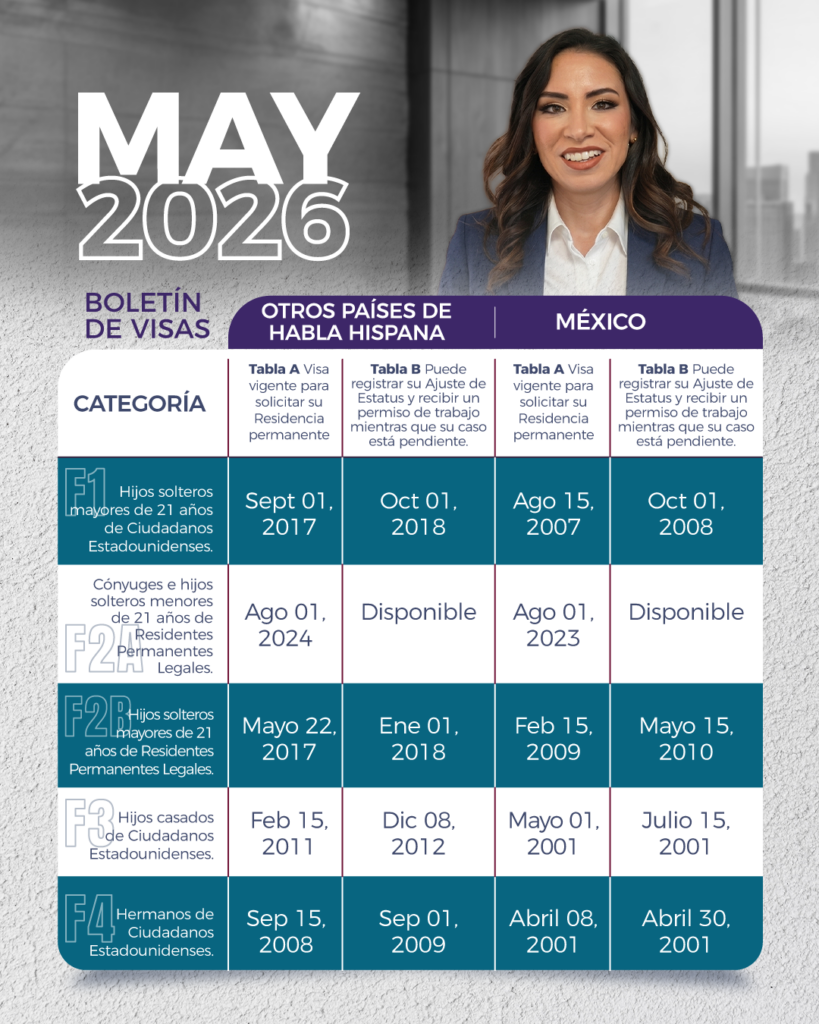
  • Formula 1 Unmarried sons and daughters of U.S. citizens.

  • F2A Spouses and minor children of permanent residents. (This category is often among the most closely watched due to its speed.).

  • F2B Unmarried sons and daughters (over 21 years of age) of permanent residents.

  • F3 Married children of U.S. citizens.

  • F4 Brothers and sisters of adult U.S. citizens.

Note for applicants from Mexico: It is fundamental to remember that Mexico has specific cut-off dates. Due to high demand, wait times for Mexican citizens are usually longer than for the rest of Latin America, so checking the correct column in the official gazette is a step you cannot skip.

Visa Bulletin April 2026

Why is monthly review crucial?

The Department of State updates these dates every 30 days based on the number of available visas and processed applications. A small month-long advance in the bulletin can practically mean you've saved months or even years of accumulated waiting. Conversely, phenomena like “date retrocession” exist, where the times move backward, so Seizing the current moment is vital.

If you have any doubts about how to interpret these tables or if this month's progress allows you to take immediate action, we invite you to seek professional advice. Each case is unique, and an error in date calculation can result in the rejection of your application or the loss of government fees.


Personalized Advice In our office, we are ready to help you decipher the April 2026 Visa Bulletin and design a tailored action plan for you. Learn more about our immigration law services and secure your future in the United States.

Legal Notice This content is provided for informational purposes only and does not constitute legal advice or create an attorney-client relationship. Every immigration case is unique and requires specific analysis. For a detailed consultation, call us at 310-803-3040.

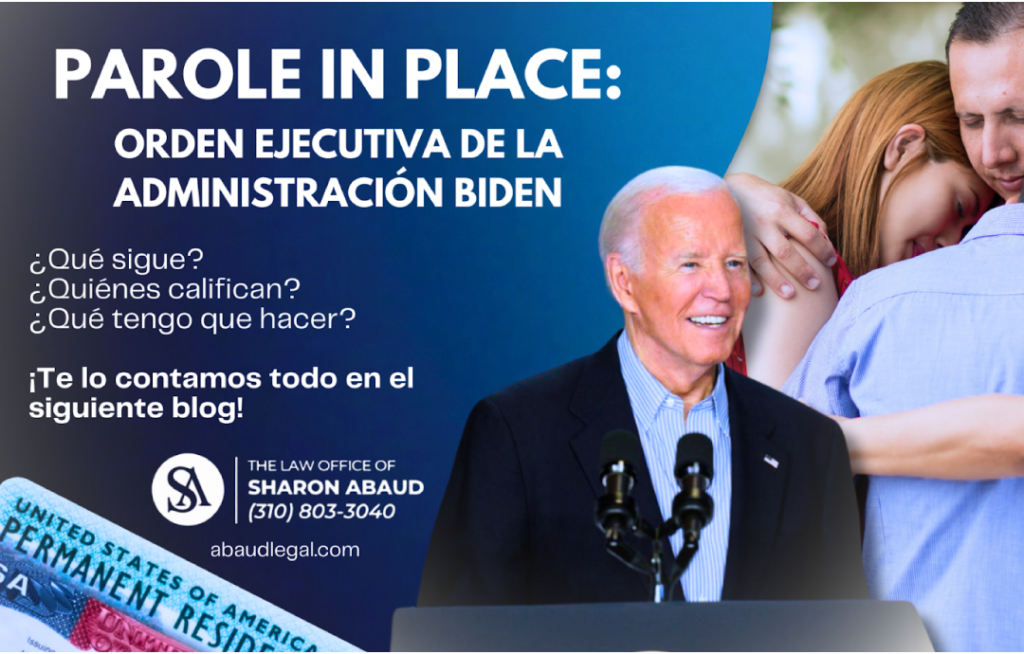
Opportunities to obtain citizenship should be equally available to everyone, regardless of where they were born or when they arrived. On June 18 of this year, the Joe Biden administration announced new legal protections for some undocumented spouses of U.S. citizens and a small number of young people.

Opportunities to obtain citizenship should be equally available to everyone, regardless of where they were born or when they arrived. On June 18th of this year, the Biden administration announced new legal protections for some undocumented spouses of U.S. citizens and a small number of young people. This measure is a very important step towards a more welcoming immigration system that will treat families with respect and dignity.

This new “Parole in Place” policy has the potential to make a real and unprecedented difference for approximately 480,000 people.

This is what you need to know about the new policy: 

By providing a “fictitious entry,” even after having illegally entered the US, this gives you the possibility of obtaining your adjustment of status without leaving the country and potentially with a “penalty.”.

1. From the August 19, 2024, eligible spouses and children will be able to apply for this process to obtain legal status while remaining with their families.

2. Two categories of people may be eligible: According to the Biden administration's announcement, to qualify, as of June 17, 2024, individuals must have resided in the United States for 10 or more consecutive years and be legally married to a U.S. citizen, while also meeting all applicable legal requirements. This means that if you married a citizen on June 18, 2024, you no longer qualify; similarly, if your spouse became a citizen on June 18, 2024, you no longer qualify.

3. The new program of Word in Place This is a small but important step in the right direction. But we need long-term security for all members of our community, not just a few. The Biden administration and Congress must immediately take more substantive actions toward a more welcoming, dignified, and just immigration system.  

Something important to consider is that this is an executive action and is subject to judicial limbo, as we saw with DACA from 2012, during the administration of Barack Obama. This can create uncertainty for those applying for parole.

We must continue to push for citizenship for all: for all our undocumented loved ones, neighbors, people trapped in temporary statuses like those with TPS, DACA, etc... and for all people seeking safety and peace. 


In The Law Office of Sharon Abaud We are ready to help you with all the legal procedures that an order of this magnitude entails. We are prepared and highly trained to accompany you throughout this process, with honesty, transparency, and great love for our community. Don't waste any more time and start preparing immediately, call us at (310) 803-3040 and we will gladly assist you.

Domestic violence is a global problem that unfortunately affects many people. However, in the United States there is a legal provision known as

Domestic violence is a global issue that unfortunately affects many people. However, in the United States, there is a legal provision known as the VAWA (Violence Against Women Act) Visa, specifically designed to provide protection and hope to victims of abuse. Here you can learn more about this Visa, who can apply, and the application process.

What is the VAWA visa and who can apply?

The VAWA Visa is a type of visa created to protect victims of abuse who are spouses, children, or parents of U.S. citizens or lawful permanent residents. This visa allows victims to leave abusive situations without fear of deportation. It is not only available to women, but men and children who are in abusive situations can also apply for it.

VAWA Visa Application Process

To apply for this visa, it is necessary to submit Form I-360, as well as provide evidence of the relationship with the abuser, joint residency, good moral character, and most importantly, proof of abuse. During this process, it is crucial to have an immigration attorney who can help organize and properly submit the application.

Advantages of the VAWA Visa

Obtaining a VAWA Visa can bring multiple benefits to victims of abuse. Unlike other visas, the abuser's cooperation is not required in the application process. Furthermore, once approved, the VAWA Visa provides work authorization and the possibility of applying for permanent residency, offering a secure path toward freedom and independence.

The path to obtaining a VAWA Visa can be complicated and exhausting, but you don't have to do it alone. An expert immigration attorney like myself can help you submit a strong application and guide you through every step of the process, providing you with the peace of mind you need during such a crucial time. The VAWA Visa is a ray of light in the darkness for victims of domestic violence, and together, we can work to obtain the justice and peace you deserve.